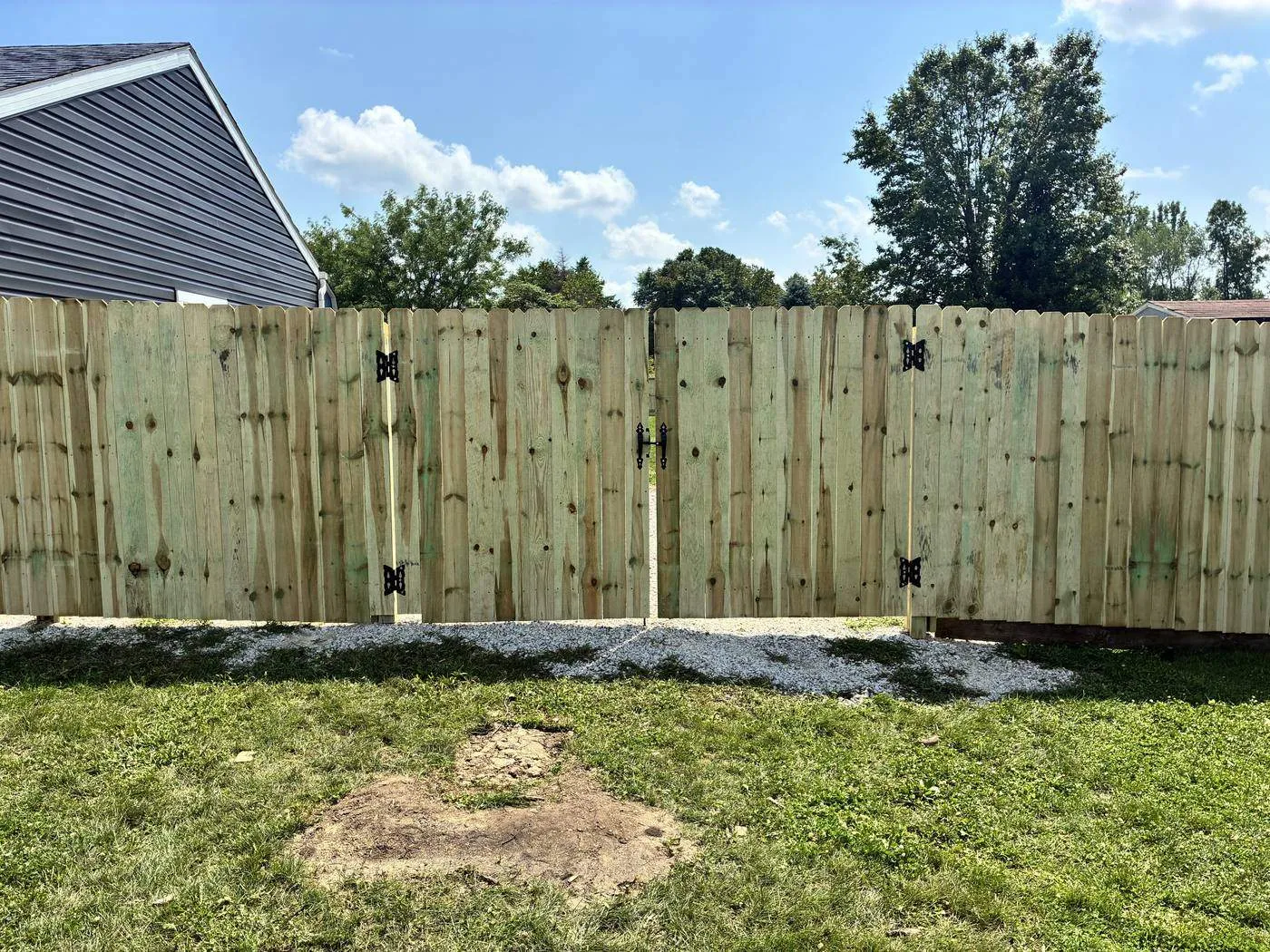
Google
Communication
“Very professional and quick service. He communicated very well with overall project.”
A gate should open smoothly, close cleanly and suit the way you use your yard. See how our wood braces, internal vinyl-gate frames and site planning work together.
The details behind your fence
Our wood gates use diagonal wood braces in compression. Our vinyl gates use an aluminum frame inside. Explore both approaches.
With the hinges on the left, our compression brace runs from the lower hinge corner toward the upper latch corner. Its fitted ends transfer load back toward the supported side.
Our vinyl gates have an internal aluminum frame. The cutaway reveals that reinforcement behind the vinyl finish; final connections follow the specified gate system.
A brace or frame works with the rest of the gate: suitable hinges and fasteners, aligned latching, and a hinge-post assembly selected for its width, weight, wind exposure and site.
The details behind your fence
Move the gate through its arc, then add a garden bed. Clear width, slope and the entire swing path all need a site check.
Use the slider or arrow keys. This demonstrates motion; it does not certify clearance.
Plan access for people, equipment and the direction of travel. Check the complete swing area, not only the opening between posts.
A bed, wall or parked vehicle can occupy the swing area. A rising grade can also reduce clearance below the gate. Review layout and support options before installation.
A swinging gate carries its weight through the hinges and hinge post. The unsupported latch side creates leverage, so gate width and weight matter as much as the fence style.
A gate can sag when its frame racks out of square. Worn or loose hinges, moving posts and failed connections can also cause misalignment. Fixing the right problem starts with checking the whole assembly.
We plan the gate as an assembly: frame, bracing, supports, hardware and clearance. Adding hinges to an ordinary fence section does not establish that those parts are suitable.
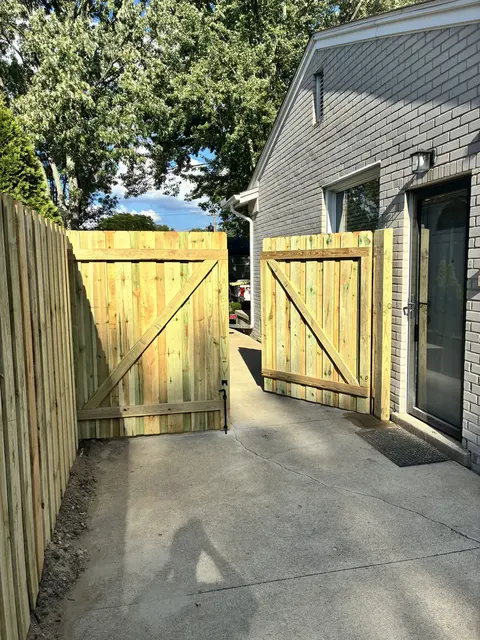
We use diagonal wood braces in compression. The important details are the direction of the brace, fitted bearing at its ends and secure connections to a suitable frame.
The brace runs from the lower hinge-side corner toward the upper latch-side corner. As the latch side loads downward, the brace transfers compression toward the supported side. Reverse the illustration for a gate hinged on the right.
A diagonal board alone does not establish strength. Its fit, condition, connections and the surrounding frame all matter. The interactive illustration shows the load direction without prescribing a universal board size.
Other engineered gate systems may use tension cables or different reinforcement. Those have their own connection and loading requirements; a cable on a new gate is not by itself evidence of poor construction.
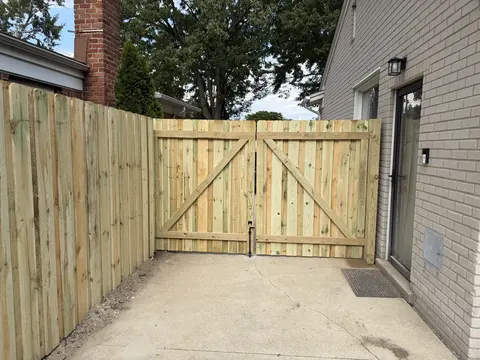
The hinge post receives the weight and movement of the gate. If that support shifts, a well-braced leaf can still stop lining up with its latch. Support selection belongs in the plan from the beginning.
Gate width, weight, wind exposure, soil and hardware determine the support requirements. A gate post may need a different assembly from a line post. Driven steel is one option where the specified system and site are suitable. Explore our no-dig approach.
We use an internal aluminum gate frame within the vinyl finish. The reinforcement supports the assembly while preserving the appearance of the selected vinyl style.
The internal frame still needs compatible connections, hinges and post support. The cutaway above explains the concept; the project proposal identifies the actual gate, opening and hardware.
Open and close each leaf through its intended travel. Check clearances, hinge security, latch operation and any hold-open or double-gate hardware. Report changes in operation so the cause can be assessed.
Plan your gate openings along with the fence.
Measure my fence →Communication
“Very professional and quick service. He communicated very well with overall project.”