Google
Care on the job
“They were on time, professional, and clean.”
Compare installation approaches for your fence, gates and ground conditions. The right post system depends on the complete design and the property.
A driven post or anchor can reduce excavation where the system and site are suitable. Another footing may be needed for a particular fence design, gate, ground condition or access constraint. We review those details before recommending how your fence should be installed.
| Question | Wood post with a footing | Steel post with a footing | Compatible driven system |
|---|---|---|---|
| What must be specified? | Post, treatment and connection | Post, finish and connection | Post or anchor and connections |
| How is embedment chosen? | According to the design and site | According to the design and site | According to the system and site |
| What sets spacing? | Fence design and loads | Fence design and loads | Fence design and loads |
| What affects durability? | Material, exposure and installation | Material, exposure and installation | Material, exposure and installation |
| What affects movement? | Ground, drainage and foundation detail | Ground, drainage and foundation detail | Ground, drainage and foundation detail |
| What ground review is needed? | Support, drainage and obstructions | Support, drainage and obstructions | Support, drainage and obstructions |
| What is the excavation scope? | Confirm in the written scope | Confirm in the written scope | May reduce excavation where suitable |
| What happens to the yard? | Agree access and restoration scope | Agree access and restoration scope | Agree access and restoration scope |
| How are later repairs handled? | Depends on the installed detail | Depends on the installed detail | Depends on the installed detail |
Look beyond the soil label. Ground conditions, drainage, fill, buried obstructions, exposure and fence loads can change the recommendation.
| What we review | Why it matters | What to discuss |
|---|---|---|
| Support and drainage | Ground conditions affect the recommendation | How the selected design addresses the site |
| Fill and obstructions | Previous work can affect installation | Any areas needing a different detail |
| Fence height and openness | Design and exposure affect loads | The specified fence and post system |
| Gate openings | Width and use affect the supporting detail | Gate posts, hardware and access |
| Equipment access | The crew must reach the proposed line | Access and site preparation |
| Connections | The visible fence must fit its supports | Rails, panels, boards and fasteners |
| Maintenance | Products have different care requirements | Care information for the selected product |
Review ground, materials, connections and access as parts of the complete installation.
Ground and water: discuss drainage, ground movement and exposure along the proposed line.
Materials and connections: confirm the specified posts, rails, fasteners and finishes.
Gate loads: an opening may need a different foundation or connection from the adjacent fence.
Maintenance and access: ask about product care and how equipment will reach the line.
Fence appearance and foundation details are separate choices. Confirm the rail layout, visible style and post system in the same written quote.
Project planning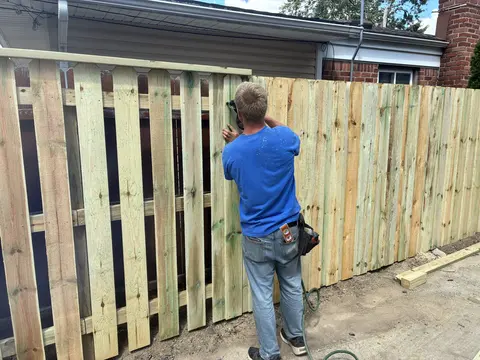
An obstruction, unsuitable support, limited access or a demanding gate or fence design may change the recommendation. We will explain the proposed approach.
Ask which post or anchor is proposed, what requirements apply, and whether any gates or sections need another detail.
Which system is proposed? How does it connect to the fence? What access and restoration work is included? Put the answers in the written scope.
Care on the job
“They were on time, professional, and clean.”